Matej Krén / Juraj Krén
Exhibition: Exhibition
Curators: Kristína Jarošová and Ivan Jančár
Location: Bratislava City Gallery, Slovakia
Date: 2020
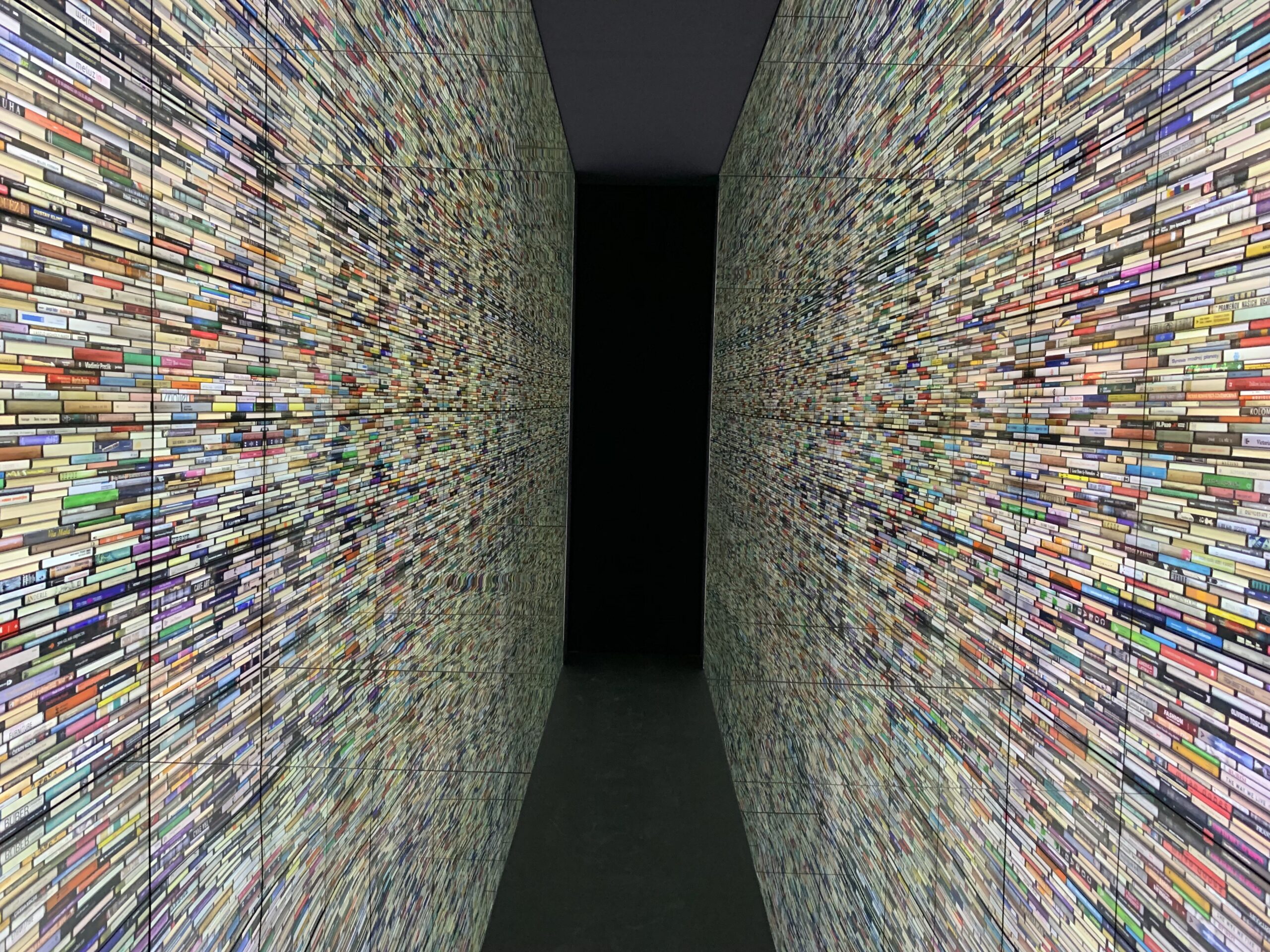
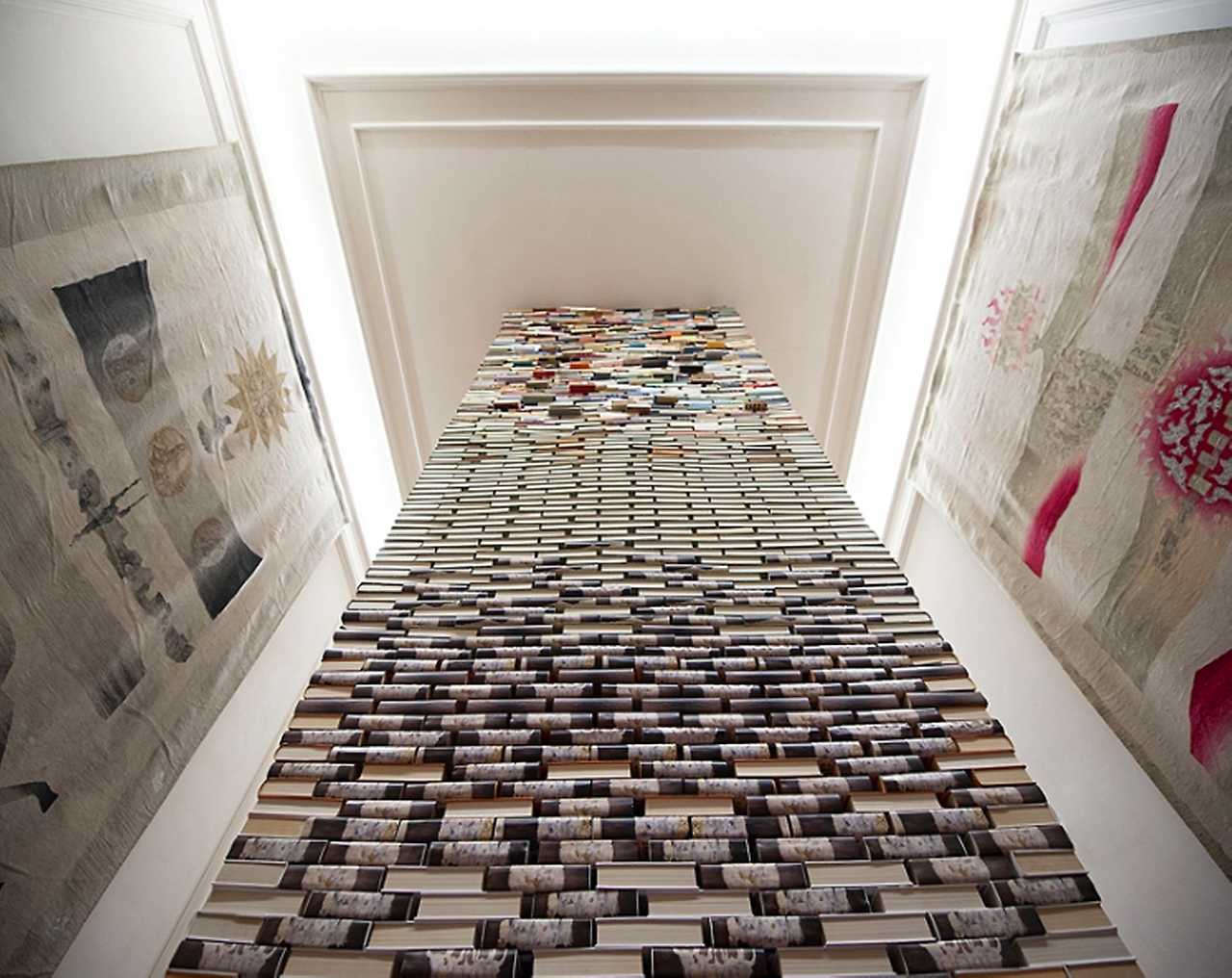
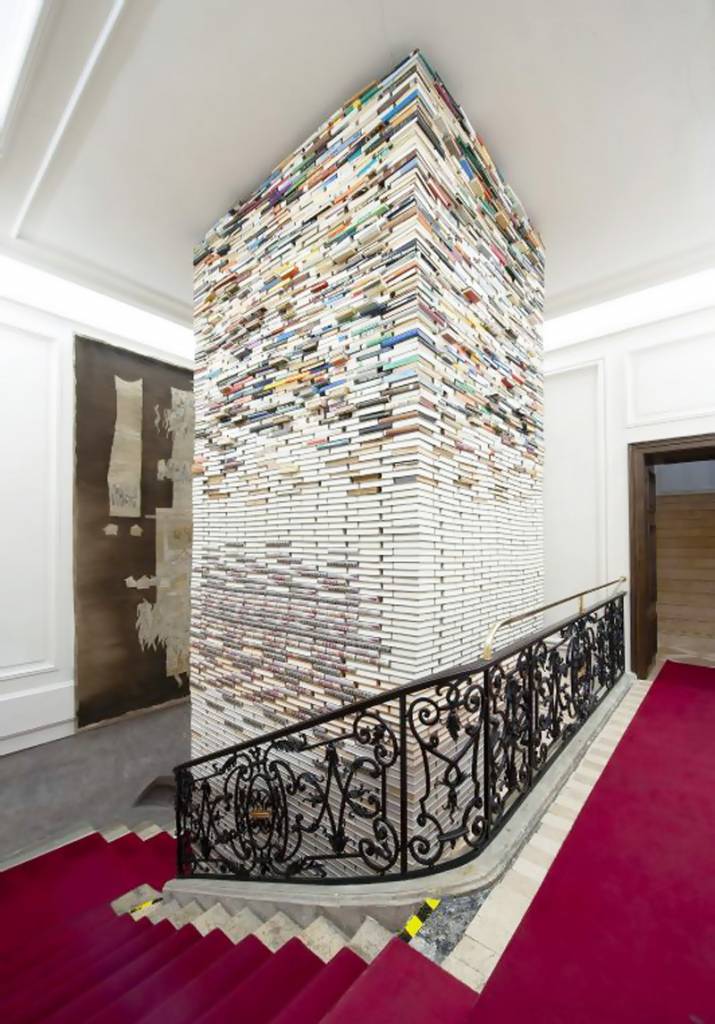
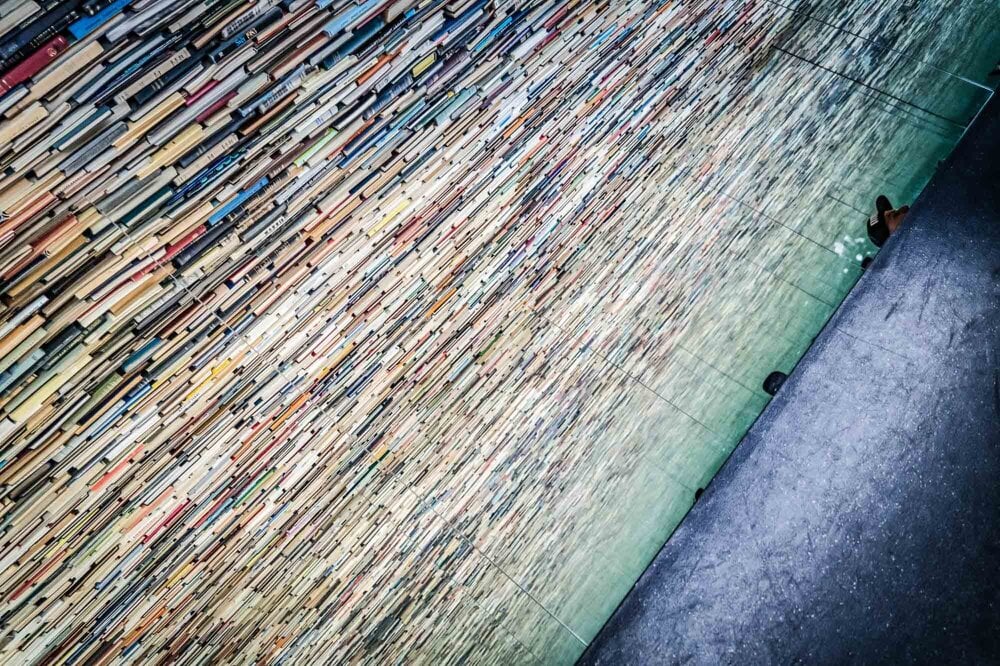



The exhibition of three works in the Pálffy Palace of the Bratislava City Gallery forms a unified whole—one that also acts as a striking intervention into the architecture and functioning of the building itself. The installation of a “lift shaft and elevator,” the creation of a “cinema hall,” and the establishment of a “storage depot” and “waste site” are not only new architectural extensions of the building’s function, but also mutually contrasting artistic gestures. At the same time, all three are closely connected through a single shared object: the book. Here, the book is not merely presented as a classical textual medium, but as a metaphorical instrument for grasping the profound shifts through which our increasingly mediatized, post-industrial society transitions into the age of information.
The opening work of the exhibition is SEMIOLIFT, a temporary architectural addition to the palace constructed from books. It represents a symbolic expression of how media infiltrates and alters our natural world and its everyday operations.
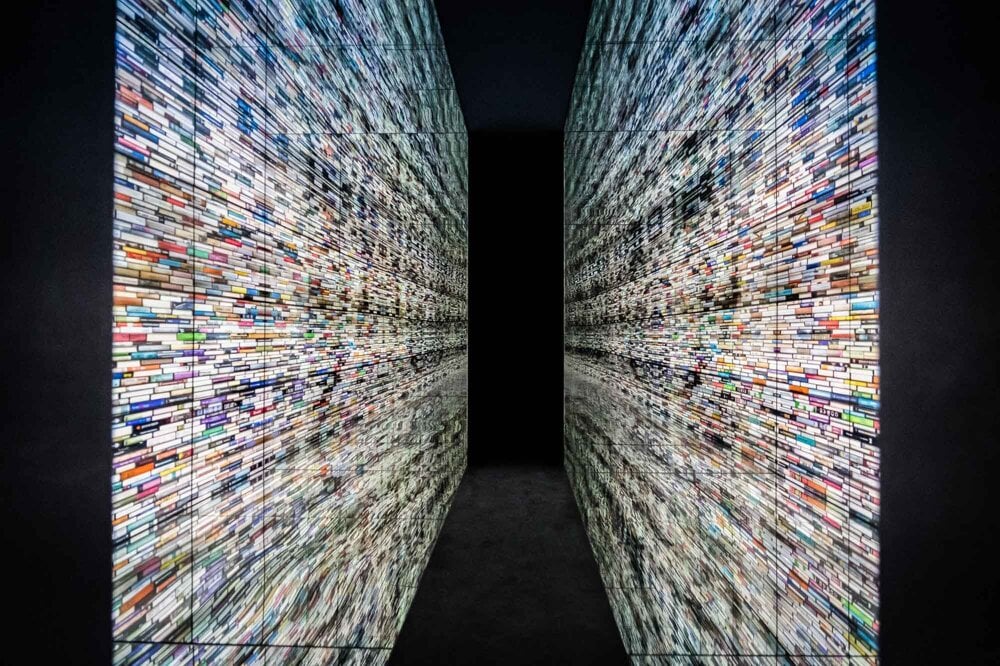
The project MNEMOCINEMA PASSAGE is a direct reference to the original PASSAGE from 2004. It adopts the original’s formal and conceptual blueprint, reconfiguring it into a new associative framework. In this iteration, real books have been removed and replaced with their simulated presence. The walls of the new passage are no longer built from firmly stacked volumes, but from their illusionary projection—animated across LCD screens.
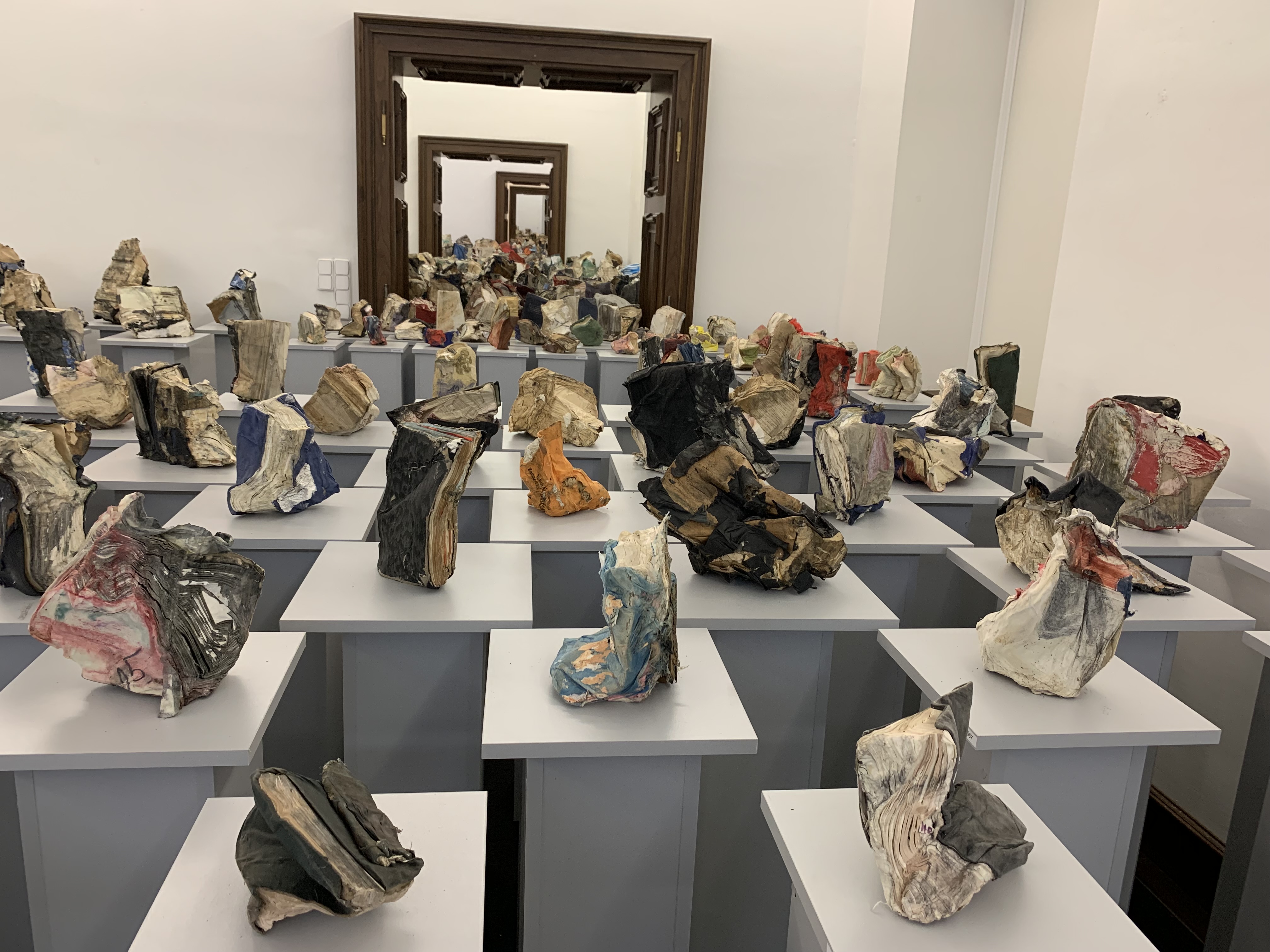
The third project, AMNESITORY, presents a collection of post-media artifacts. Each object is created from books discarded by public libraries and subjected to processes akin to recycling. This destructive transformation was halted just before the books’ complete disintegration. The structure of the entire project—from the selection of objects and their spatial arrangement to the nature of the lighting—gradually evolves in meaning and intensity. The overall organization of the work is guided by the specific constellation of exhibition spaces within the Pálffy Palace.
SEMIOLIFT
The newly coined term Semiolift consists of the words “semiotic” and “lift.” Semiotics, the theory and study of signs and their meaning and encoding, is among the key tools used in analyzing contemporary society and culture. It allows for the interpretation of historic acts as well as the creation and transformation of new ones.
Besides being a monumental sculpture, Semiolift is also sophisticated architecture—architecture within architecture—communicating with the staircase in Pálffy Palace and its fragments of Gothic architectural elements. There is also an association with Gothic spiritualism. The work follows the structure of tapestries by Juraj Krén (the artist’s father). The structure of the work changes, and a more detailed inspection reveals fragments of texts. In total, however, the work appears as a colorful painting, with its upper parts reduced to pure white surfaces.
Semiolift preserves its mystery of discovery, as though it is always concealing something from us. The viewer gradually uncovers its individual parts and changing outer and inner structures. The work is like a chameleon, altering its colors depending on the environment. The height of the tower evokes the Tower of Babel—the structure that led to the confusion of languages.
Semiolift may be perceived as an entrance gate to the exhibition, comprised of three installations. The viewers make two journeys: they take a lift (illusory) and climb the stairs. During the first journey, they are provided with time for meditation, while the second one requires physical performance. The vertical illusion—like a symbolic journey to paradise or to hell—prevails. The illusion of ascension is suggested by the synchronous animation of books on the side walls of the lift, where the flow of book titles simultaneously transitions to the ceiling screen, creating the impression of a passing semiotic universe.
The time spent in the lift symbolizes a state in which a person, in a kind of hyper-presence, is confronted with a depiction of the world that, as the artist believes, is altered through their “metaphysical” mental activity.
Unlike the artist’s previous book installations, here the viewers find themselves in a closed space that they cannot leave. They are left alone with their feelings, unable to consult their ideas. Apart from virtual reality and simulated universes, they have little experience of movement within endless space; a different sensory experience arouses different associations.
The digital “nub of the problem” is located within the interior of a monumental book structure that fills the stairwell. At certain moments, regularly arranged book titles are “erased” by white covers, only to reappear—suggesting the hope of a continuation of something that, in the endless course of history, cannot be halted. However, uncertainty remains, reinforced by the moving and sprung elevator floor in this seemingly playful installation. The feeling of dizziness, emptiness, and the possibility of falling activates the viewers’ senses, confronting them with the uncertain state in which they find themselves.
PASSAGE MNEMOCINEMA
The work Passage Mnemocinema elaborates on the intentions of Passage, which became a part of the Bratislava City Gallery’s permanent installation in 2004. Passage gained international recognition and was interpreted in many different ways. It seemed almost impossible to further develop its idea and visual effect. However, after fifteen years, Matej Krén returned to the work, reflecting on the radical changes our society is undergoing in the digital era—including the transformation of media, human beings, and the world itself.
The title Passage Mnemocinema was created using a Duchampian method based on the fusion of meanings resulting from different spellings and pronunciations: Mnemocinema – Mnemosyne. A neologism, Mnemocinema refers to the field of associations linked with the concepts of memory and film projection. It also alludes to Mnemosyne, the ancient Greek goddess, and to the river of the same name, which possessed magical powers to manipulate the forgetting of past lives.
In this context, the motif of flowing through the realm of Hades is crucial—not to mention the problem of death and reincarnation. Mnemosyne (μνημοσύνη, “memory” in Greek) is the personification of memory in Greek mythology. Mnemosyne is also the mother of the nine Muses, the goddesses of arts and science, whose father was Zeus. According to some sources from the 4th century BCE, Mnemosyne was also a river in Hades—the counterpart to the river Lethe. Dead souls who drank from Lethe forgot their past lives before reincarnation, while the initiated were instructed to drink instead from the Mnemosyne, the river of memory.
Comparing the titles Passage and Passage Mnemocinema, the shift in interpretation is evident, with deliberate parallels retained in their structure and formal rendering. The problem of re-interpretation is among the key themes of the exhibition, although this may not be immediately apparent. In today’s world, interpretation has become a crucial issue—one that, along with symbolic representation, is radically reshaping our perception of reality.
The visually captivating installation consists of books and mirrors—the “building blocks” that have long been used and subjected to various artistic transformations. The book represents the vast potential of human existence; it is a carrier of meaning, word, sign, writing, memory, and intergenerational experience. The mirror functions as an extension of reality, or as the boundary between reality and illusion. The third architectural element consists of projection screens displaying books moving in different directions and at varying speeds.
The tangle of book titles, metamorphosed into a digital library, seems no longer intended for human eyes. The contents in digital media flow like a river. Paradoxically, information overload and the constant expansion of knowledge push us to the limit of comprehension—potentially leading to superficiality, apathy, and emptiness. The fictional abyss beneath the narrow pathway in the passage highlights both the drama of sensory perception and the existential drama of our time.
Here, the viewer enters a world that appears symbolic and fictional. However, from the artist’s perspective, it is precisely the world we inhabit:
“After leaving the passage, our thoughts and actions are so conditioned by what we have experienced inside that we remain captives of the passage. The possibility of freedom is full of contradictions. As Kafka put it, man experiences his greatest sense of freedom while passing from one cage to another—or from one passage to another—but it is only for a moment, and it is only an illusion.”
The exterior architecture of the work is stark and austere, while the interior is dynamic and ever-changing. As with Passage Mnemocinema, the viewer need not step inside to experience the sensation of infinite space and movement. The view from the outside already evokes this feeling. Yet, the work “captures” and “entices” the viewer, inviting them to become part of it.
In its infinite nature, the work becomes a symbol of the expectation of eternal life, envisioned by Jorge Luis Borges as a paradise constructed from an endless number of books. The work also evokes the cyclic repetition of certain historical challenges—suggesting that progress is not always linear and that looking backward is sometimes necessary.
The constant substitution of symbolic representation for reality raises concerns about the emergence of a simulated, fictional world—one that may seem advantageous for both its creators and users. We are becoming participants in a “game” that we ourselves have initiated and produced, yet one that can easily take control over us. Passage Mnemocinema seeks to uncover, through the illusion of captivating fiction, other layers of fiction and captivity within the unbearable lightness of digital existence, as well as the state of a spiritual journey toward infinity.
The work teeters between various levels of meaning—between the obvious and the hidden, the real and the illusory, the permanent and the ephemeral. Through its repeated explorations of symbolic representation and reinterpretation, it reaches the core of the matter, striving to comprehend and decode the transformations taking place.
AMNESITORY
The installation Amnesitory shifts our focus from the captivating Mnemocinema Passage to a post-apocalyptic vision of the world and human existence in the digital era. The fluidity of illusion in a simulated, boundless space is suddenly replaced by complementary structures that seem to return us to reality—revealing the true face of our existence, which today discreetly hides behind the digital curtain of new technologies.
As the words in the title suggest—amnesia (memory loss) and depository (storage, archive)—viewers find themselves in a space that associates the dissolution of the entire spiritual human universe with the paper bodies of books. Here, the books are no longer used as building materials; they have been considerably transformed. The viewer is confronted with their dilapidation, facing the borderline situation of their self-transformation into matter devoid of meaning.
The mechanical process of recycling, in the form of pressing, destroys the books at a time when their message is in grave danger—on the verge of total oblivion. After their structure has been altered, they can no longer be opened or read; their contents are almost entirely lost. Here and there, tiny fragments—letters and words—of texts emerge. However, they are merely empty frames of their original existence, which has vanished in the flow of time.
As if taking part in a farewell ritual, the physical corpus of the books lingers, yet their real meaning and content have disappeared, existing only in human memory. The books are subjected to severe attacks and brute force. The vulnerability and transience of a book are confronted with the possibility of its transformation. Paradoxically, their destruction grants them a new artistic presence. Regardless of their content, each book takes on a unique artistic poetics.
The entire organization of the collection adheres to the common principles of similar archives, including a cataloging system for the individual “items.” The structure of the whole is arranged into separate sections of the project, categorized by various distinguishing keys, evoking a false sense of distance and a cold detachment from the process of disappearance and dissolution.
The books of Pijoan’s History of Art, displayed in the first room, serve as metaphors for the destruction of the entire history of art as we know it—or its transformation into another form. Initially arranged in strict order, they gradually dissolve into complete chaos. Once again, the virtual system describing the world appears to take precedence over its actual dissolution.
The configuration of the pedestal bases for the individual books continuously changes, with the final room remaining physically inaccessible. The sensation of the depository’s infinite continuation becomes a parable, endlessly repeating the same message: the suggestive presence of the boundary between a physically unattainable world and the viewer’s reach. A fragile paper parable of the soul, this remains the ultimate message—one that, even in its dissolution, holds the only hope.
The vision of disappearing books serves as a broader metaphor for what is unfolding in the spiritual and historical realms. The best interpretation of this concept is captured in Walter Benjamin’s reflection on Paul Klee’s work:
“A Klee painting named Angelus Novus shows an angel looking as though he is about to move away from something he is fixedly contemplating. His eyes are staring, his mouth is open, his wings are spread. This is how one pictures the angel of history. His face is turned toward the past. Where we perceive a chain of events, he sees one single catastrophe that keeps piling wreckage upon wreckage and hurls it in front of his feet. The angel would like to stay, awaken the dead, and make whole what has been smashed. But a storm is blowing from Paradise; it has caught in his wings with such violence that the angel can no longer close them. This storm irresistibly propels him into the future to which his back is turned, while the pile of debris before him grows skyward. This storm is what we call progress.”
(Benjamin, Walter: Theses on the Philosophy of History, Illuminations. New York: Schocken Books, 1969, p. 249.)
Text by: Kristína Jarošová, Ivan Jančár